
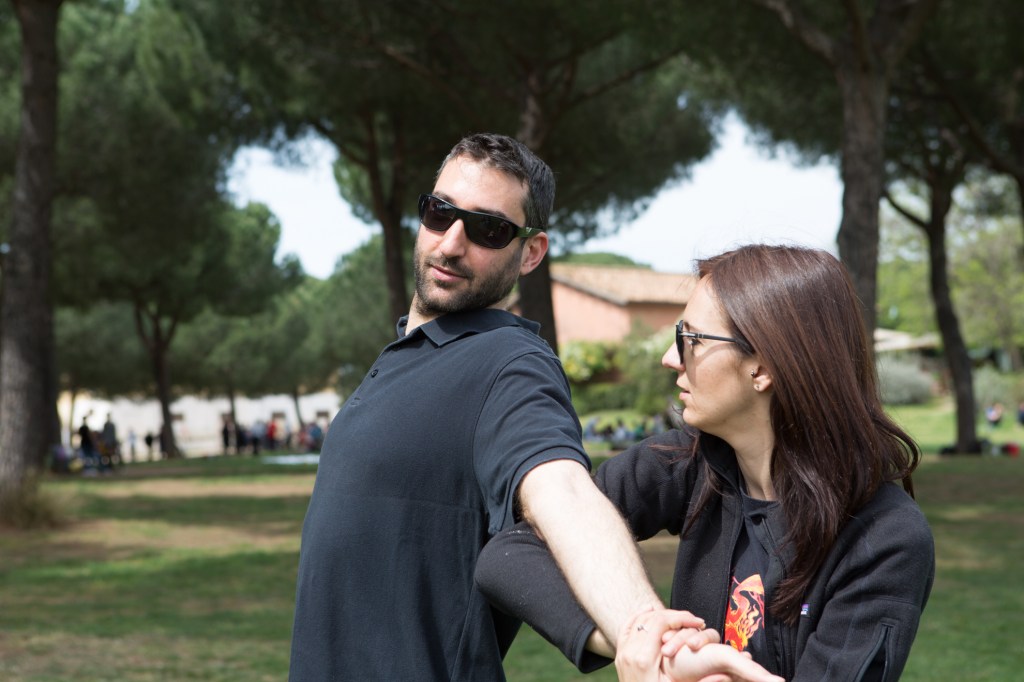
Tai Chi, although known for its slow, graceful movements, contains martial applications that can be applied in self-defense situations. Each movement within the Tai Chi forms can be interpreted as a martial technique or application. The slow, flowing motions are not just for health and meditation but also for understanding the principles of self-defense.
Here are a few examples of how some Tai Chi movements have martial applications:
- Ward Off (Peng): The circular, deflecting motion used in the Ward Off movement is applied to redirect an opponent’s force. It involves moving incoming force away, finding balance, and using the opponent’s energy against them.
- Roll Back (Lu): Roll Back is a technique to redirect an incoming attack or force. The practitioner uses the opponent’s energy and redirects it while maintaining their own balance and stability.
- Press (Ji): The Press movement involves applying forward pressure and breaking an opponent’s balance while maintaining a relaxed yet forceful action.
- Push (An): Push is a technique that uses a forward force against an opponent, disrupting their balance and creating distance.
- Single Whip: This movement can represent a strike or a grappling technique, using the hand’s edge for a strike or to control an opponent’s limb.
Tai Chi martial applications focus on principles such as balance, relaxation, sensitivity, and using the opponent’s force against them rather than meeting force with force. Practitioners learn to yield, redirect, and neutralize an opponent’s energy, often using circular and flowing movements.
It’s important to note that understanding the martial applications of Tai Chi often comes after a deep study and practice of the art. Tai Chi as a martial art emphasizes self-cultivation, self-awareness, and defense without aggression. Many practitioners may focus primarily on the health and meditative aspects of Tai Chi without delving deeply into the martial applications.
 Miami Taichi